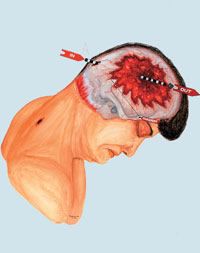
Tuesday, 15 July 2014

How Dave Reitzes Gets it Wrong Part 3


“Back and to the Left”: The Zapruder Film

The most striking moment of the Zapruder film arrives at frame 313 when President Kennedy's head explodes and his entire upper body is slammed violently backwards and leftwards. Although I don't believe it's accurate to say, as Reitzes does, that the “head snap” has been held up by critics as “irrefutable proof of conspiracy”, there is no doubt that to the majority of us laymen it certainly gives the immediate impression that the fatal shot came from the right front. In fact, after Zapruder's home movie was shown on television for the first time in 1975, public outrage was so great that it ultimately resulted in the formation of the House Select Committee on Assassinations.


But as Reitzes is quick to point out, numerous medical experts convened by government panels have consistently reassured the American public that “back and to the left” doesn't prove anything. He quotes experts for the Rockefeller Commission in 1975 who were “unanimous in finding that the violent backward and leftward motion of the President's upper body following the head shot was not caused by the impact of a bullet coming from the right front.” One of these specialists, Dr. Alfred Olivier—who had previously worked as the chief ballistics expert for the Warren Commission—claimed, unsurprisingly, that the President's movement “could not possibly” be the result of a frontal shot and “attributed the popular misconception to the dramatic effects employed in” movies and television.


However, the government's experts failed to provide evidence to support their assertions. Even in the 1970s, films showing victims of rifle shots to the head were readily available. I myself have seen old black and white wartime films of kneeling prisoners being shot in the back of the head with bolt action rifles. In each case, the victims did not lurch drastically back towards the shooter but fell forwards onto their faces. Regardless, the Rockefeller experts chose not to provide documented examples to buttress their position and instead offered two theories, the “neuromuscular reaction” and the “jet effect”, neither of which has withstood scrutiny.

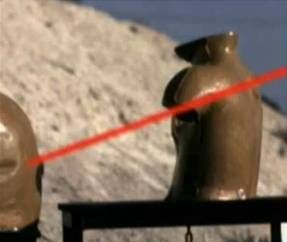
The “jet effect” suggests, that in a similar fashion to the thrust developed in a rocket or jet engine in response to its exhaust, the explosive exiting of blood and brain matter from the right side of Kennedy's head created a corresponding propulsive momentum in the opposite direction. The theory was the brainchild of Nobel Prize-winning physicist and stern Warren Commission supporter, Dr. Luis Alvarez, who—though he kept the fact to himself—was paid by the government to conduct his study. (David Wrone, The Zapruder Film: Reframing JFK's Assassination, p. 103) Alvarez demonstrated the effect by shooting a high powered rifle at melons resting on fence posts which caused the melons to recoil back towards the shooter. But as scientist Dr. Donald Thomas explained in his fine book, Hear No Evil: Social Constructivism & the Forensic Evidence in the Kennedy Assassination, Alverez had rigged the tests.

Firstly, the melon is not, as Dr. Alvarez claimed, a “reasonable facsimile of a human head.” In fact, as Dr. Thomas writes, “a melon differs from a human head in precisely those characteristics that make the jet effect implausible in the latter, but possible in the former.” (Thomas, p. 359) A melon weighs approximately half as much as a human head and so requires less energy to set in motion. It also lacks a bone which means that it offers little resistance to a bullet so that there is little deposition of momentum and, consequently, very little force to overcome. “By minimizing the deposition of momentum, using a target with little resistance,” Dr. Thomas writes, “Alvarez was free to work on the other end of the equation, by jacking up the velocity.” Dr. Alvarez used a high-powered 30.06 rifle instead of the lower velocity Mannlicher Carcano and hot-loaded his cartridges to 3000 feet per second. (Ibid) When another Warren Commission defender, Dr. John Lattimer, attempted to duplicate Alvarez's tests using an actual Mannlicher Carcano and factory ammunition, he did not achieve the jet effect. His melons simply fell off the pedestal; sometimes backwards and sometimes forwards. (Ibid, p. 362)

Dr. Thomas also makes the point that in order for the jet effect to be a viable explanation for the backward motion, the exit wound, or the “vent”, would have to have been in the very front of the skull. But the massive wound to Kennedy's skull involved most of the right side, from the temple back to the occiput. And if the vent was on the right side, “then the jet effect would have driven the head to the left (the side opposite the vent) not backwards.” (Ibid, p. 358) As Dr. Thomas summarizes, “...the President did not have an exit wound in a position that would have caused his head to move rearward if there was a jet effect.” (Ibid, p. 370)

As it's explanation for the backwards motion, the HSCA favoured the neuromuscular reaction—a theory that was put to the committee by ballistics expert, Larry Sturdivan, who had worked at Edgewood Arsenal under Dr. Alfred Oliver. Sturdivan put his hypothesis in the simplest possible terms for last year's Cold Case: JFK television special: 

“The tissue inside the skull was being moved around. It caused a massive amount of nerve stimulation to go down his spine. Every nerve in his body was stimulated. Now, since the back muscles are stronger than the abdominal muscles, that meant that Kennedy arched dramatically backwards."

But as Dr. Thomas explains, "Sturdivan's postulate suffers from a patently anomalous notion of the anatomy. In any normal person the antagonistic muscles of the limbs are balanced, and regardless of the relative size of the muscles, the musculature is arranged to move the limbs upward, outward, and forward. Backward extension of the limbs is unnatural and awkward; certainly not reflexive. Likewise, the largest muscle in the back, the 'erector spinae', functions exactly as its name implies, keeping the spinal column straight and upright. Neither the erector spinae, or any other muscles in the back are capable of causing a backward lunge of the body by their contraction." (Thomas, p. 341) Additionally, the type of reaction Sturdivan posits is simply not in keeping with what we see on the Zapruder film. Kennedy's movement did not begin with an arching of the back. As the ITEK corporation noted following extensive slow motion study of the Zapruder film, his head snapped backwards first, “then his whole body followed the backward movement.” (ITEK report, p. 64)

Reitzes writes that immediately before the backward motion appears on the Zapruder film, Kennedy's head moves forward by 2.3 inches. This, he suggests, is the “instant of impact” of a bullet entering the back of the head. This alleged forward motion was first reported by Josiah Thompson in his book, Six Seconds in Dallas, but Thompson has since changed his mind about its very existence. In his online article, Bedrock Evidence in the Kennedy Assassination, Thompson writes: “In the years since those measurements were made, I've learned I was wrong. Z312 is a clear frame while Z313 is smeared along a horizontal axis by the movement of Zapruder's camera. The white streak of curb against which Kennedy's head was measured is also smeared horizontally and this gives rise to an illusory movement of the head. Art Snyder of the Stanford Linear Accelerator staff persuaded me several years ago that I had measured not the movement of Kennedy's head but the smear in frame 313. The two-inch forward movement was just not there.”

On the other hand court certified Crime Scene Investigator, Sherry Fiester, believes Thompson's initial observations were correct. She characterizes the alleged forward motion as a "movement into the force" of a shot from the front. Citing a number of ballistics studies, Fiester explains, "Once a bullet enters the skull...the bullet immediately loses velocity. The loss of velocity results in a transfer of kinetic energy...This initial transfer of energy causes the target to swell or move minutely into the force and against the line of fire." (Fiester, Enemy of the Truth: Myths, Forensics, and the Kennedy Assassination, p. 245)

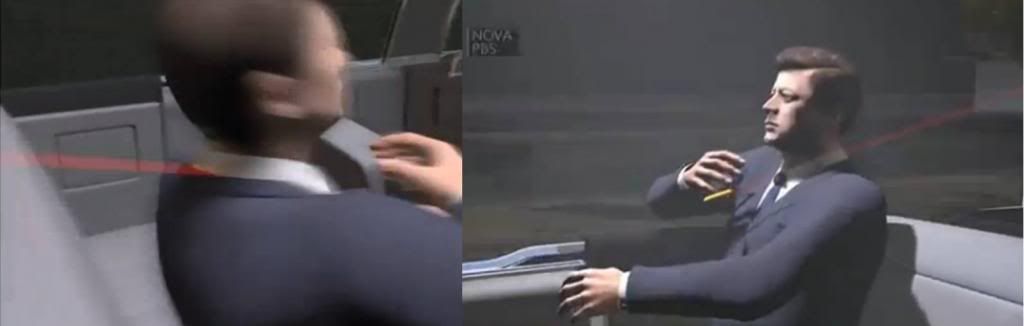
The reader will have to do their own research and decide for themselves whether Thompson or Fiester is correct but there is something else that needs to be considered. That is, the motions of the other occupants of the Presidential limousine who, the Zapruder film shows, all moved forward at the time of the head shot and continued their forward motion after Kennedy's body was sent hurtling backwards. This is clearly demonstrated in the these two animations from researcher David Wimp:


It stands to reason that these people, who all made the same motion, were all affected by the same force. That force would appear to have been the deceleration of the limousine. If Dr. Alvarez's calculations are correct, then it appears that the President's car began to slow down a little under one second before the head shot at approximately Zapruder frame 300. (Thomas, p. 340) This was apparently the result of Secret Service driver Willaim Greer touching the brakes—an inexplicable act that caused many bystanders to believe that the limousine came to a virtual standstill during the assassination.

So, if Greer tapping the brake caused the other limo passengers to lurch forward, then it quite probably was responsible for any forward motion on the President's part. There is, then, no compelling reason to accept Reitzes' hypothesis that Zapruder frames 312 to 313 captured the “instant of impact” of a shot from the rear.


Sunday, 6 July 2014

How Dave Reitzes Gets it Wrong Part 2


The Parkland Hospital Professionals

The observations of the trauma room doctors and nurses who attempted to save President Kennedy's life have long been a thorn in the side of Warren Commission followers and lone gunman theorists. This is because, as Reitzes admits, “many of these medical professionals made observations indicative—some strongly so—of shots from the President’s front rather than the rear.” For example, Professor and Director of Neurological Surgery at Parkland, Dr. Kemp Clark, swore in his Commission testimony that he had seen a wound “in the back of the President's head. This was a large, gaping wound in the right posterior part, with cerebral and cerebellar tissue being damaged and exposed." (6H20) Similarly, Dr. Robert McClelland noted that “the right posterior portion of the skull had been extremely blasted. It had been shattered...so that the parietal bone was protruded up through the scalp and seemed to be fractured almost along its right posterior half, as well as some of the occipital bone being fractured in its lateral half, and this sprung open the bones that I mentioned in such a way that you could actually look down into the skull cavity itself and see that probably a third or so, at least, of the brain tissue, posterior cerebral tissue and some of the cerebellar tissue had been blasted out...." (Ibid, 33)

Despite Reitzes' erroneous and unsupported claim that “the testimony of the Parkland doctors and nurses is highly contradictory and confused”, the above descriptions of a defect in the right rear of the skull were supported by the statements and/or testimony of every other trauma room participant. The only exceptions were Dr. Kenneth Salyer—who stood on JFK's left and did not get a good look at the wound (Ibid, 81)—and Dr. Aldoph Giesecke who, for some reason, got his left and right confused but nonetheless recalled that the wound extended into the occiput. (Ibid, 74) As should be obvious, the appearance of a gaping wound in the right rear of the skull is very much suggestive of a shot from the front.

Then there's the wound in the throat which, from all descriptions, appeared more like an entrance than an exit. Dr. Malcolm Perry told autopsy surgeon Dr. James Humes that the hole was a mere 3-5 mm in diameter. (17H29) He further explained in his Commission testimony that "It's edges were neither ragged nor were they punched out, but rather clean cut." (3H372) Dr. Charles Carrico recalled that the wound measured “4-7 mm...It was, as I recall, rather round and there were no jagged edges or stellate lacerations." (6H3) And Dr. Ronald Jones described it simply as a “very small, smooth wound.” (Ibid, 54) It goes without saying that a neat, round wound measuring between 3 and 7 mm is not what one would expect from an exiting 6.5 mm rifle bullet. In fact, tests performed for the Commission at Edgewood Arsenal demonstrated that such wounds typically measure up to 15 mm. (17H846)

None of this matters in the least to Reitzes. He dismisses it all with the wave of a hand and states matter-of-factly that “they [the Parkland staff] were wrong”. He offers no explanation, elaboration, or—heaven forbid!—discussion of the evidence. Instead he cites a “A study published in 1993 in the Journal of the American Medical Association...comparing the post-mortem findings of a board-certified forensic pathologist to the previous assessments made by trauma specialists”. According to Reitzes, “the study found that the trauma specialists made errors about the nature of bullet wounds (such as the number of bullets involved and in distinguishing between entrance and exit wounds) in 52 percent of the cases.” Whilst this is an intriguing statistic, Reitzes never explains how it relates to the observations of the Parkland staff, let alone how it supports his contention that they were wrong.

As Reitzes tells it, the JAMA study addresses the assessment of wounds, i.e. the question of entrance versus exit. But this has nothing to do with the location and size of the wounds observed by the Parkland trauma room staff. It in no way suggests that a Professor of Neurosurgery, as was Dr. Clark, would be unable to tell the back from the front of the head. Nor that qualified physicians like Dr. Perry and Dr. Carrico would be unable to tell smooth from ragged or 3 mm from 15 mm.

So what exactly does Reitzes think the Parkland doctors were wrong about? He cannot be saying that the autopsy showed they were wrong about the damage to the right rear of the skull because the autopsy report confirms that “the large irregular defect of the scalp and skull on the right” extended into the “occipital” region (in fact, the X-rays show extensive damage to the upper right rear of the skull). And Reitzes cannot be saying that they were proven wrong about the size and appearance of the wound in the throat because that would be absurd. As chief pathologist Dr. Humes explained in his Commission testimony, he had been unaware of the wound in the throat when he performed the autopsy because a tracheotomy had been performed on top of it at Parkland Hospital. It wasn't until the following day, when he no longer had access to the President's body, that Humes spoke to Dr. Perry and learned of its existence. (2H362) But by then it was too late to ascertain the true nature of the wound.

I can only assume that what Reitzes means to say is that critics are wrong to infer from the testimony of the Parkland physicians that shots were fired from the front. But the JAMA study he cites fails to support that proposition. A study which suggests “the odds that a trauma specialist will correctly interpret certain fatal gunshot wounds are no better than the flip of a coin” does not change the fact that the wounds were where they were and looked how they looked. The hole in the throat was still a “very small, smooth wound”. And the damage to the head as seen at Parkland was still in “the right posterior portion of the skull”.

Nothing that Reitzes has to offer in any way demonstrates that the Parkland professionals were wrong in their key observations.

Blow-Ups

Reitzes spends a few paragraphs discussing Mary Moorman's famous Polaroid photograph which shows, in rather fuzzy detail, the Grassy Knoll approximately 1/5 of a second after the fatal head shot. Picking an easy target, he largely concentrates on describing how researcher David Lifton saw various assassins in the photograph that were, in actual fact, all as imaginary as his ridiculous body alteration theory. Reitzes also dedicates a paragraph to Gary Mack's “Badge Man” image which gathered some interest when it first appeared on television in 1988 but few critics take seriously nowadays. Unsurprisingly, the most intriguing find—made by author Josiah Thompson in 1967—barley gets a mention.

As Thompson explained in his classic book, Six Seconds in Dallas, to see if “the hypothesis of a shot from the stockade fence” could be “validated by the Moorman picture”, he compared it to another photograph taken from her position some time later. What he discovered was that an “anomalous shape” appeared along the fence line in Moorman's photograph that was not present in the comparison picture. He then took eyewitness S.M. Holland “to the assassination site and asked him to stand in the position where he found the curious footprints and saw the smoke”. Thompson took himself back to Moorman's position and saw that, remarkably, Holland's head “appeared in the exact position defined by the shape” in the Polaroid. (Thompson, p. 127)

Whilst the above might be dismissed as a simple coincidence, it becomes all the more interesting in light of evidence first made public by the House Select Committee on Assassinations in 1978. The HSCA was presented with a Dallas Police dictabelt recording made at the time of the assassination that, according to analysis by the top acoustics experts in the United States, contained an impulse with the acoustic fingerprint of a shot fired from the Grassy Knoll. When the Committee's experts were asked to pin down the location of the alleged Grassy Knoll gunman, their analysis pointed to the very same spot behind the fence—approximately 8 feet left of the corner—in which Holland stood and in which the anomalous shape appears in Moorman's picture. (8HSCA29) As Thompson later noted, this means that there is a “remarkable convergence of evidence”, eyewitness, photographic and acoustic, “concerning not just a shot from the Knoll from some shadowy corner, but the exact location of a shot from the Knoll...The evidence doesn't lead to various locations and to various battles over which location is correct. Rather, it leads to one, single, unambiguous location.”


Tuesday, 24 June 2014

Omission, Misrepresentation & Oversimplification: How Dave Reitzes Gets it Wrong Part 1

Last year, the clearly misnamed Skeptic magazine published an article titled "JFK CONSPIRACY THEORIES AT 50: How the Skeptics Got It Wrong and Why It Matters". The article was written by Dave Reitzes, himself a conspiracy theorist until he "saw the light" a few years ago. Having read the piece, it is abundantly clear to me that its purpose was not, as was claimed, to remind us "that the job of a skeptic is to use critical thinking to properly assess the evidence", but was simply to lump all of those who don't believe the official story of the Kennedy assassination together for ridicule and marginalisation. Being one of those who firmly believes that there was a conspiracy behind the assassination, some might expect me to begin this response by attacking and belittling Reitzes himself. But as I believe the man who pops up on JFK forums every now and then solely to patronize and provoke—or "troll" to use the popular vernacular—would only enjoy it, I have no intention of giving him the satisfaction. Instead I shall concentrate on his most important arguments (such as they are) regarding the evidence.

The Grassy Knoll Witnesses

Since virtually day one, critics have suspected, based on eyewitness accounts, that a shot or shots were fired at President Kennedy by a gunman stationed behind the fence on top of the now infamous "Grassy Knoll". So it's really no surprise to see Reitzes begin his anti-conspiracy rant here. It has been estimated that there were up to 700 witnesses in Dealey Plaza that day and, as Reitzes admits, their opinions as to the source of shots were very much divided. Long-time researcher, Stewart Galanor, compiled a  survey of 216 known witness accounts and reported that, of those with an opinion as to the source of gunfire, 48 believed the shots came from the Texas School Book Depository whereas 52 thought they came from the Knoll. Many would argue that this suggests shots were fired from both directions but, for obvious reasons, Warren Commission apologists and anti-conspiracy buffs like Reitzes choose to explain things differently.

Reitzes makes reference to the "confusion, shock, and pandemonium at the scene of the crime" and "the fragile nature of eyewitness testimony—particularly during moments of highly elevated stress". He also notes that a "bioacoustics expert conducting experiments in Dealey Plaza for the House Select Committee reinvestigating the crime in 1978" noted that there were “strong reverberations and echoes”. And he provides a quote from the "authoritative textbook" Firearms Investigation Identification and Evidence which states, “It is extremely difficult to tell the direction [from which a shot was fired] by the sound of discharge of a firearm.” Reitzes adds, "The authors go on to note that 'little credence' should be placed in such testimony."

That last part is, for me, the most immediately interesting because it reveals a lot about Reitzes' methodology and intellectual dishonesty. Despite the impression he tries to convey in the main text of his article, Reitzes has not read what he nonetheless assures is "the authoritative textbook", Firearms Investigation Identification and Evidence. His footnote reveals that the quotes he provided from that book actually came to him second-hand via Vincent Bugliosi's awful lone nut screed, Reclaiming History. But Reitzes unsurprisingly chose not to use the complete second quotation which reads, "little credence...should be put in what anyone says about a shot or even the number of shots. These things coming upon him suddenly are generally extremely inaccurately recorded in his memory." [my emphasis] (Bugliosi, p. 848) Reitzes was careful to eliminate the highlighted part about the number of shots. Why? Because he wants to have his cake and eat it.

Because it falls in line with the Warren Commission findings, Reitzes makes a big song and dance about the fact that "81 percent of the witnesses who expressed an opinion believed there had been precisely three shots". So, whilst doing his best to convince readers that eyewitness testimony about the sound of gunshots is inherently unreliable and, therefore, the number of witnesses who thought they heard shots from the Knoll is essentially meaningless,  Reitzes nonetheless implies that the fact that a large number of witnesses thought they heard three shots is still to be considered significant. Obviously, quoting his chosen experts on that particular point would not have helped his case. So he carefully excised the inconvenient parts of the quotation.

Given the "strong reverberations and echoes" that Reitzes mentioned, the large number of people reporting hearing three shots is actually more odd than it is compelling. Last year, NOVA's Cold Case: JFK special featured acoustics expert, Professor Michael Hargather. He explained to viewers that "Multiples buildings, multiple locations that the shockwaves reverberate off of can give us multiple sound signatures...In a complicated geometry like Dealey Plaza in Dallas, you could get multiple shock reflections in that geometry. And so someone could hear multiple sounds from a single shot." That being the case, it is reasonable to suggest that, if they were working from their own uninfluenced memories, a good percentage of the Dealey Plaza witnesses should have reported hearing more shots than they did. So why did so many recall hearing three? As it turns out, the Warren Commission provided the most reasonable explanation: "Soon after the three empty cartridges were found, officials at the scene decided that three shots were fired, and that conclusion was widely circulated by the press. The eyewitness testimony may be subconsciously colored by the extensive publicity given the conclusion that three shots were fired." (Warren Report, p. 100-111)

Reitzes also fails to tell the whole story when discussing the "bioacoustics expert" who informed the House Select Committee on Assassinations of the aforementioned "strong reverberations and echoes" observed during test shots fired in Dealey Plaza. In actual fact, there was not one but three psychoacoustic experts present for the on-site tests; Dr. D.M. Green, Dr. Dennis McFadden and Professor Frederick Wightman. Whilst three sequences of test shots were fired from the Texas School Book Depository or the Grassy Knoll, the experts placed themselves at various locations in the plaza and recorded their impressions as to the origin of the sounds. The results were unambiguous. Shots fired from the TSBD sounded like they came from the TSBD and shots from the Knoll sounded like shots from the Knoll. (see HSCA Hearings & Appendix Vol. 8, p. 144) It is difficult to say precisely what relevance this has to a study of the assassination witnesses since, as the experts noted, "The emotional condition of our observers during the test and the emotional condition of the people during the assassination were undoubtedly quite different." (Ibid, p. 146) But there can be little doubt that it undermines Reitzes' attempt to dismiss all reports of shots from the Knoll as simply echoes or reverberations. And this is especially true in light of the visual observations Reitzes was careful to make no mention of.

Several witnesses, including S.M. Holland, Richard Dodd, James Simmons and Thomas Murphy, reported seeing puffs of smoke coming from behind the picket fence atop the Knoll during the shooting. When called to testify by the Warren Commission, Holland recalled hearing "four shots", the third or fourth of which was accompanied by "a puff of smoke" coming "right out from under those trees". (6H244) Simmons, who was not called to testify, told author Mark Lane in a filmed interview that he had heard a sound like a "loud firecracker or a gunshot" coming from behind the wooden fence "and there was a puff of smoke that came underneath the trees on the embankment". Almost immediately after the shooting stopped, both Holland and Simmons ran to the area behind the wooden fence, apparently to see if they could find the shooter, but it took them a minimum of two minutes to reach the area and, as Holland noted, "They could have easily have gotten away before I got there". (Mark Lane, Rush to Judgment, p. 35) Consequently all they found, according to Simmons, was "footprints in the mud around the fence, and...on the wooden two-by-four railing on the fence" as well as "on a car bumper there, as if someone had stood up there looking over the fence". (Ibid, p. 34)

Lone nut authors like Gerald Posner and Vincent Bugliosi—both of whom are cited by Reitzes—have claimed that what witnesses like Holland and Simmons saw could not have been smoke from a rifle because modern ammunition is "smokeless" and, in Posner's words, "seldom creates even a wisp of smoke". (Posner, Case Closed, p. 256) This is not so, however, according to firearms expert Monty Lutz who told the HSCA that it would indeed have been "possible for witnesses to have seen smoke if a gun had been fired from that area". Lutz explained that "both 'smokeless' and smoke producing ammunition may leave a trace of smoke that would be visible to the eye in sunlight. That is because even with smokeless ammunition, when the weapon is fired, nitrocellulose bases in the powder which are impregnated with nitroglycerin may give off smoke, albeit less smoke than black or smoke-producing ammunition. In addition, residue remaining in the weapon from previous firings, as well as cleaning solution which might have been used on the weapon, could cause even more smoke to be discharged in subsequent firings of the weapon."(HSCA Vol. 12, p. 24-25) Thanks to the internet, we don't need to rely on dishonest authors like Posner and Bugliosi, or even experts like Lutz. It is a simple matter to find videos like this one showing a single rifle shot creating a considerable amount of smoke.

Reitzes ends his "discussion" of the Grassy Knoll witnesses by pointing out that "of the dozens of witnesses who described the sound of the shots, very few (you could count them on one hand) said that they came from more than one direction", which  is very true. But although Reitzes obviously hopes to leave the impression that this somehow supports the official story, in light of the "confusion, shock, and pandemonium at the scene of the crime" to which he alluded—and the results of the HSCA's psychoacoustic tests which he ignored—it is difficult to know precisely how much significance to attach to it. It is certainly reasonable to suggest that, for many of the witnesses, their impression as to the source of the shots was informed by only one of the shots they heard and they naturally assumed that the other sounds were coming from the same direction.

Friday, 20 June 2014

The Watchman Waketh but in Vain: Howard Willens Responds


Back in March of this year, former Warren Commission lawyer Howard Willens added to his blog an ill-advised and thoroughly inadequate response to my review of his misnamed book, History Will Prove Us Right. In my review I pointed out a number of glaring omissions by the author and provided several examples of blatant dishonesty on his part. I summed up Willens's stance as one of obvious denial, advising that he needed to wake up and admit the world was round, and ultimately concluded his book was simply not worth reading. I showed, using in many instances the official evidence, that the Commission began with dishonest intentions and operated with a pre-ordained outcome in mind. Not surprisingly, Willens, who has taken over the indefatigable David Belin's role as principle defender of the Commission, was none too pleased with my fact-based appraisal.

Willens first takes issue with my use of the now infamous Katzenbach memo which, he says, I use to support my “proposition that the Commission's investigation was a total fraud on the American people.” Actually, I used much more than just that memo to demonstrate my point. I showed how, the day after the assassination, President Johnson was shocked by information he received from the CIA implicating Oswald in a plot orchestrated by Castro. I showed how Johnson used that information to twist Earl Warren's arm into chairing the Commission, impressing upon him the importance of avoiding war with the Soviets. And I quoted from a memo of Warren's first meeting with the Commission's staff in which he passed the message on, emphasising that “this was an occasion on which actual conditions had to override general principles.” But, just like in his book, Willens doesn't want to talk about any of this. He limits the discussion to the Katzenbach memo which, quite ridiculously, he still cannot bring himself to quote from or put into context.

Let's do that now.

Only hours after Lee Harvey Oswald was gunned down by Jack Ruby, Deputy Attorney General Nicholas Katzenbach wrote the following: “The public must be satisfied that Oswald was the assassin; that he did not have confederates who are still at large; and that the evidence was such that he would have been convicted at trial...Speculation about Oswald’s motivation ought to be cut off, and we should have some basis for rebutting thought that this was a Communist conspiracy or (as the Iron Curtain press is saying) a right–wing conspiracy to blame it on the Communists.”

It is absolutely clear from the above that long before any such thing had been proven, Katzenbach was flatly suggesting the American people needed telling that the evidence established there had been no conspiracy and Oswald was the lone assassin. But as I noted in my review, at that point in time there was not a single eyewitness against Oswald and his prints had not been found on the alleged murder weapon. In fact, only the previous morning, FBI Director J. Edgar Hoover had stated in a phone conversation with LBJ that “The evidence that they have at the present time is not very very strong.” A few minutes later, Hoover candidly admitted, “The case as it stands now isn't strong enough to be able to get a conviction.” Between the time of that phone call and the time Katzenbach sat down to write his memo, the only thing of substance that had changed was that the accused assassin was now dead and would not have to face trial.

Contrary to what Katzenbach advised the public be told, on the evening of November 24, 1963, not only was the evidence not “such that he [Oswald] would have been convicted at trial”, but everyone in government had plenty of reason to suspect a conspiracy. In fact, at that time, the CIA was still feeding the White House disturbing reports of Oswald's alleged activities in Mexico City shortly before the assassination. As I wrote in my review:

On Saturday, November 23, LBJ met twice with CIA director John McCone who briefed him about Oswald's alleged visit to Mexico City two months earlier. Based on information sent to headquarters by the CIA's Mexico City station, McCone reported that Oswald had been in contact with Soviet consular Valery Kostikov, whom it was alleged was an expert in assassinations. Shaking Johnson up some more, the CIA followed this up on Monday, November 25, with a cablegram from Mexico City Station Chief Winston Scott, who claimed to have uncovered evidence that Castro, with Soviet support, had paid Oswald to kill Kennedy.

Katzenbach later admitted in his testimony before the House Select Committee on Assassinations that he had been fully aware of the reports coming out of Mexico City. So he had to have known that there were many credible leads still to be followed regarding a possible conspiracy (assuming one considers the CIA credible), just as he had to have known—as Hoover did—that there was no evidence proving Oswald guilty of pulling the trigger. Put into this context, the Katzenbach memo can only be viewed as a blatant instigation of a whitewash. There is quite simply no other reasonable point of view so it is no surprise that even his “rebuttal” Willens cannot bring himself to divulge or face these facts.

According to Willens, it is “sheer foolishness” to suggest that Johnson, Katzenbach, or anyone else influenced the Commission or its staff. “When I was asked to assist the Commission,” he writes, “neither Katzenbach nor anyone else gave me directions as to what I should do...” Whilst in all honesty I doubt Willens is telling the truth, I obviously cannot prove it. But what I can say is that his colleague on the Commission staff, Wesley Liebeler, apparently had a different story to tell when he took a very important witness named Silvia Odio to dinner after taking her first testimony. According to Odio's interview with Church Committee investigators, Liebeler had stated that evening, "Well, you know if we do find out that this is a conspiracy you know that we have orders from Chief Justice Warren to cover this thing up." Asked if Liebeler had really said that, Odio replied, “Yes, sir, I could swear on that.” (Probe, Vol. 3 No. 6)

In his continued attempt to bolster the integrity of his colleagues, Willens repeats the old canard that “most of the staff lawyers were eager to prove that the FBI's initial report was incorrect in some important respects and to find that a conspiracy existed.” All I can really say in response is that if you believe this nonsense, then I have a bridge to sell you. I mean, really, was Joseph Ball looking to prove the FBI wrong when he blatantly led Helen Markham into identifying Oswald as the killer of Dallas Police officer J.D. Tippit? Was Wesley Liebeler looking for a conspiracy when he failed to ask Patrolman Joseph Smith for a description of the fake Secret Service Agent on the Grassy Knoll? What about Arlen Specter when he warned Dallas Doctor Ronald Jones that he didn't want him talking about shots from the front? (see Parkland Trauma Room One Reunion video at approx. 29:10) Or David Belin when he suborned perjury from Texas School Book Depository employee Charles Givens? As the old saying goes, actions speak louder than words. And the actions of the Commission's staff clearly demonstrate that finding a conspiracy was the last thing on their minds.

In my review, I pointed out that when Willens was given the job of staffing the Commission, he did not look for experienced, independent investigators and instead hired a bunch of Ivy league lawyers. Willens responded by pointing out that the “FBI, CIA, Secret Service, and other federal agencies” had been investigating the assassination for six weeks before the Commission began its work. Which of course is part of the problem. Those agencies, who misled and withheld important information from the Commission, should have been suspects and not the principle investigators. Ah! But, Willens claims, the Commission did not rely on the FBI to supply the evidence. Oh no. It “based its conclusions” on “the sworn testimony from 550 witnesses”. Which is about as weak and misleading a response as I can imagine. Who was it that went out and found the vast majority of those witnesses and told the Commission who it needed to speak to? Oh, that's right, the FBI and “other federal agencies”. And in numerous cases they worked hard to ensure those witnesses would testify in a “favourable” manner.

A perfect example would be the case of friend and aide to President Kennedy, Kenny O'Donnell, who was riding in the Secret Service car behind the Presidential limousine when the shots rang out. As O'Donnell later revealed to House Speaker Tip O'Neil, “I told the FBI what I had heard [two shots from behind the grassy knoll fence], but they said it couldn’t have happened that way and that I must have been imagining things. So I testified the way they wanted me to. I just didn’t want to stir up any more pain and trouble for the family.” (O'Neil, Man of the House, p. 178) Riding in the follow-up car with O'Donnell was Dave Powers who corroborated O'Donnell's account in an interview with authors Lamar Waldron and Thom Hartmann, saying he was pressured to change his testimony “for the good of the country”. (Ultimate Sacrifice, p. 106)

Then there is the case of Dallas physician Dr. Malcolm Perry who, on the afternoon of November 22, told the press that JFK had an entrance wound in his throat only to seemingly change his mind when he appeared before the Commission months later. As the Church Committee discovered in 1975, Dr. Perry's change of heart was a direct result of pressure applied by Secret Service Agent Elmer Moore who went on to play a curious role as somebody's mole on the Commission. (Jim DiEugenio, Reclaiming Parkland, p. 143-144)

As we can see from the examples above, in important instances testimony taken by Commission lawyers was tainted by the fact that the federal agents who acted as its investigators had gotten to the witnesses first. And that's the witnesses the FBI wanted to deal with. There were many more whom the Bureau simply ignored or, if they could not, worked hard to discredit. And the Commission played along. On top of this is the fact that, despite Willens's protestations, the Commission did rely almost exclusively upon the FBI for the collection and analysis of all crucial physical and forensic evidence. The only time the Commission sought “outside” expertise was when the FBI reported that the bullets removed from Officer Tippit could not be traced to Oswald's revolver. In that instance the Commission went out of its way to find itself an expert who was willing to say the opposite. So much for the “determined independent lawyers” eager to “find a conspiracy”! A decade and a half later, presumably using advanced techniques, the firearms panel for the HSCA determined that the FBI had been right all along and the Tippit bullets “could not be exclusively identified” as having been fired from Oswald's pistol. (7HSCA377) Clearly the Commission had rejected the best evidence in favour of that which suited its agenda.

Willens finally attempts to dismiss the remaining 4000+ words of my review with the following:

“The rest of Hay’s review is a very familiar mishmash of allegations claiming that the CIA immediately after the assassination began a 'campaign to lay the blame for the assassination at Castro’s feet' through an anti-Castro exile group that he claimed was funded by the CIA and had some contact with Oswald during the summer of 1963.” As anybody who has read it can attest, there is far more to the rest of my review than the story of Oswald and the DRE. I will go into detail about what else Willens ignored below. But first, let's set the record straight.

It is not simply an “allegation” that Oswald had contact with the anti-Castro Student Revolutionary Directorate—or the DRE, as it was known—it is a fact. Perhaps Willens needs to go back to his copy of the Warren report (p. 407) to read about how Oswald was arrested in a street scuffle with DRE Delegate Carlos Bringuier during the summer of 1963 and how the pair later appeared together in a radio debate. Nor is it an “allegation” that the DRE was funded by the CIA. As this CIA document clearly states, the group was “conceived, created, and funded by the CIA”. The DRE was overseen by a career Agency officer named George Joannides who, in a brazenly obfuscatory move, was later pulled out of retirement to act as liaison between the CIA and the HSCA in the committee's requests for information about anti-Castro groups. Needless to say, Joannides did not tell the HSCA about the Agency's creation and control of the DRE nor was the Committee informed of Joannides's role. Honestly, you couldn't make this stuff up! And finally, that the CIA-funded DRE moved to link Oswald's name to the Castro regime in the national press within hours of his arrest is not an “allegation”, it's just what happened. (see 10HSCA85)

The final point of substance in my review that Willens elects to comment on has to do with the dubious appointment of former CIA Director Allen Dulles to the Commission. Willens writes, “I have often wondered myself as to why he was named...I have no first-hand information about this appointment...” Hold the phone there, Howie. You conveyed no such hesitance or ignorance in your book when you wrote matter-of-factly that President Johnson “had asked Robert Kennedy to suggest possible commission members from the private sector. Kennedy proposed Allen Dulles...” (History Will Prove Us Right, p. 26) Given that in my review I showed quite clearly that the contemporary record entirely contradicted any such claim, I'm not surprised Willens is backing off this nonsense now. I just wish he had the courage and integrity to admit his error.

Willens ends his response by chastising my “total absence of any recognition that the critical findings of the Warren Commission have been examined on several occasions since 1964 and found, without exception, to be correct.” He goes on to say that I “fail to acknowledge” the conclusions of the HSCA; namely that JFK was struck by only two shots fired by Lee Harvey Oswald. Willens is correct, I did not discuss the HSCA conclusions in my review. Nor will I do so in detail here. I did not and do not have the time, space, or inclination to do so then or now. I will simply note that those conclusions are a sad reflection of the fact that, just like the Warren Commission, the HSCA ended up being a political exercise and not an honest investigation. Sure, the Committee started out promisingly under Chief Counsel Richard Sprague. But when Sprague was ousted for daring to challenge the CIA, and for making it clear that he was determined to discover the full truth, the HSCA went straight down the toilet. Sprague's replacement Robert Blakey was, in the words of former HSCA staff investigator Gaeton Fonzi, “an experienced Capitol Hill man” who “knew exactly what the priorities of his job were by Washington standards, even before he stepped in.” [for those who want to understand where and how the HSCA went wrong, Fonzi's brilliant book The Last Investigation is the ideal starting point.]

Now let's get to some of the most important information in my review that Willens did not even acknowledge let alone attempt to rebut. He could not acknowledge it because it reveals his own dishonesty. And he cannot not rebut it because it is the truth. In section V of my review, I discussed the Commission's mishandling of the medical evidence and Willens's attempted defense of it. I will not attempt to include all of the details here—instead referring readers to my original review—but essentially I showed how the Commission dealt with three important issues:

1. The throat wound was described by all professional medical personal at Parkland Hospital as having all the characteristics of a typical entrance wound.

2. The back wound was probed at autopsy and found to be shallow with no point of exit.

3. The autopsy photos showed the back wound to be lower than the hole in the throat.

I used the transcript of the Commission's own executive session to show that it was fully aware of what the autopsy photos revealed. I explained how it chose not to publish the report of FBI Agents Sibert and O'Neil, who were present at the autopsy, and avoided calling them to testify in order to keep the shallow probing of the back wound out of the record. And I noted how the Dallas doctors were pressured into changing their opinions about the nature of the wound in the throat. But Willens, as I explained, takes a different approach in his book. He ignores the location of the back wound altogether so as to avoid the trajectory problems with the Single Bullet Theory. But more importantly he tries to make the controversy about the nature of the two non-fatal wounds disappear by confusing events and attributing a false mistake to the FBI. As I wrote in my review:

Willens...writes that the FBI was mistaken about JFK's back wound because it “relied in part on the initial, but inaccurate, information from Parkland Hospital that the first bullet that hit Kennedy had not exited from his body.” That's right, he conflates two separate events so that he can effectively make the controversy about the throat wound vanish whilst simultaneously making it appear as if the shallow probing of the back wound at autopsy was nothing more than a mistaken observation made by emergency room staff! This is one of the most disgustingly dishonest things I have ever read in any book dealing with the assassination of President Kennedy. It says a lot about Willens's integrity—and the desperation of the lone nut crowd in general-that he has to stoop so low.

What can we say about Willens's integrity now, knowing that he read the above passage and chose not to comment? I have exposed what I can only characterize as a deliberate falsehood by the author intended to deceive readers about the true facts of the Kennedy assassination and Willens has nothing at all to say? Can Willens not see that this is precisely why so many people will never accept the official story; because defending it requires telling lies or ignoring inconvenient truths?

Ultimately I must ask, is Willens's massively deficient response to my review really the best defense this guardian of the Warren Commission's reputation can come up with? Does he really believe his shallow and misleading reproof really has any hope of improving the Commission's standing? Because he utterly failed in his stated intention of exposing my “mistakes”. He failed because he ignored key facts and omitted relevant details. He failed because he could not bring himself to confront the evidence under discussion. He failed because he could not even bring himself to admit his own gross errors and deceptions.

Truly the watchman waketh in vain.


Tuesday, 26 November 2013

NOVA Cold Case JFK: A Case Study in Cherry-Picking and Misrepresentation

Thanks to the wonders of youtube, I finally got around to seeing the recent PBS/NOVA TV special, Cold Case JFK, which wasn't shown on UK terrestrial television. Although the website claims that the purpose of the show was to see if "modern forensic science" can "uncover new clues" about the assassination, it is obvious to anyone with more than two working brain cells that looking for "new clues" couldn't have been further from the minds of its producers and participants. Its true purpose was to rehabilitate the findings of the long-discredited Warren Commission by "proving" the Single Bullet Theory, and to dispel notions of a second shooter and, therefore, a conspiracy. In so doing, the producers of the show and its two ballistic experts, the father-and-son team of Luke and Mike Haag, cherry-picked and misrepresented the actual evidence in the case and shamelessly misled millions of viewers. A review of the facts fudged or ignored in Cold Case JFK demonstrates that the SBT is as impossible now as it was in 1964 when it was first proposed by Commission lawyer, Arlen Specter. And that the evidence of a second shooter remains as strong as ever.
 
Back in Time
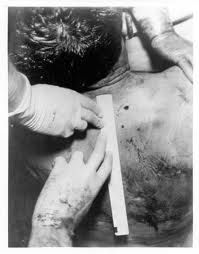
The first and most obvious deception in the show is the elevating of JFK's back wound into his neck. This, of course, is what the Warren Commission did nearly 50 years ago in order to facilitate the SBT. They were able to get away with it then, for a short time at least, because they didn't publish the autopsy photos and instead published this deceptive drawing prepared at the direction of pathologist James, J. Humes:


For their computer animation simulating the path they claim the bullet took through President Kennedy, NOVA turned back the clock to when we were kept largely in the dark on the medical evidence, and adopted the Commission's entrance location:

 
But as the makers of the show know full well, because they say so themselves, JFK's rear entry wound was not in his neck as the Warren Commission claimed, it was lower down on his back. In fact, according to the nine-member forensic pathology panel for the House Select Committee on Assassinations (HSCA), it was below the shoulders and below the wound in the throat. (7HSCA92)


So what would happen if a bullet entered at this point in the back and followed a straight-line trajectory out the front of President Kennedy? The Discovery Channel knows the answer to this question. Because when they attempted to simulate the SBT in the real world, shooting at specially made torsos from a crane set at the height of the sixth floor window of the Texas School Book Depository, this happened:


That's right, precisely as common sense would dictate, the bullet, travelling on a downward trajectory of 20 degrees, exited through the chest! This simple fact is, by itself, enough to invalidate the SBT. The makers of Cold Case JFK obviously knew this and so they moved the back wound inches above where it actually was in order to make an impossibility appear plausible. Thus their blatant dishonesty and their desire to validate the SBT at all costs was immediately revealed.
 
CE399: The "Mashed" Bullet?
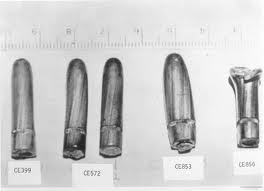
Of the many objections raised to the SBT over the years, critics have had a hard time accepting that the bullet itself, dubbed Commission Exhibit 399, could have pierced seven layers of skin and flesh and smashed two bones only to appear in virtually pristine condition on a stretcher in Parkland Hospital. And it hasn't just been Joe public who has found the notion difficult to swallow. For example, famous pathologists Dr. Milton Helpern and Dr. Cyril Wecht both strongly objected to the Warren Commission's premise. In his 1979 testimony before the House Select Committee on Assassinations, Dr. Wecht remarked that he had repeatedly urged his colleagues in forensic pathology to come up with one bullet that had done what it was alleged CE399 had done and remained in such remarkable condition. "...at no time", he said, "did any of my colleagues ever bring in a bullet from a documented case...and say here is a bullet...it broke two bones in some human being, and look at it, its condition, it is pristine." (1HSCA337) More than 30 years after Dr. Wecht's testimony, we are still waiting for a similar example to be produced by defenders of the SBT.
 
For Cold Case JFK, Luke and Mike Haag pretended to address this issue by firing a Carcano bullet into pine boards. What they found is exactly what the late  Dr. John Nichols reported decades ago; Carcano rounds are capable of penetrating three feet of pine whilst remaining in a near-pristine state. Which is all very interesting. But it doesn't address the real issue: What happens to Carcano bullets that penetrate flesh and bone? Thankfully, tests performed for the Warren Commission at Edgewood Arsenal have already answered this question for us.
 
 
Seen in the picture above, CE853 represents a bullet fired through the rib of a goat. It is severely flattened with its lead core extruding from its base. CE856 is a bullet fired through the wrist of a human cadaver and it exhibits the "mushrooming" effect typical of a bullet that has struck bone. Each of these bullets has broken only one of the two bones attributed to CE399 which, as you can see, looks virginal by comparison. None of this was mentioned by NOVA. Instead, one of the show's talking heads, the objectionable John McAdams, tried to assure viewers that CE399 is more damaged than they've been led to believe. "If you look at it end on", he claims, "it's mashed very considerably". Mashed very considerably? This bullet?:
 

Who's he trying to kid?

For his 1985 book, Reasonable Doubt, author Henry Hurt performed his own tests. As he wrote, "Firing these bullets into water consistently produced nearly pristine slugs, strikingly similar to the Magic Bullet." (Hurt, p. 385) In actual fact, the test bullet pictured in Hurt's book looks almost exactly like CE399, slightly flattened base-end and all.


Yaw(n)
So how the hell could CE399 do all that damage and emerge looking just like a bullet that had been fired into water? This is an important question that supporters of the official fairy tale have struggled for decades to adequately address. But according to the Haag team, the answer lies in the supposed fact that the bullet was "yawing" or "tumbling" when it struck Governor Connally. This is actually not an original claim, it's as old as the SBT itself. And just like the SBT, it's based on little more than the desire of its proponents to believe it's true.
 
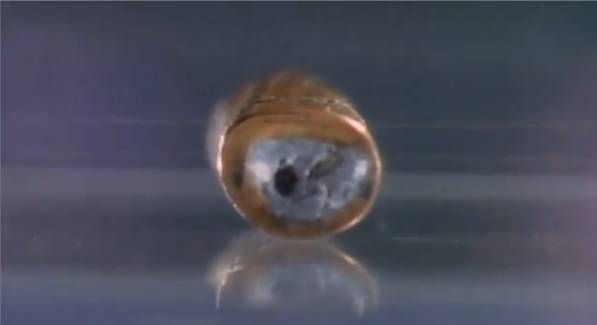
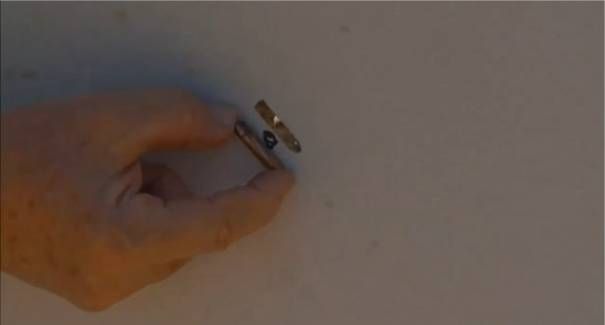
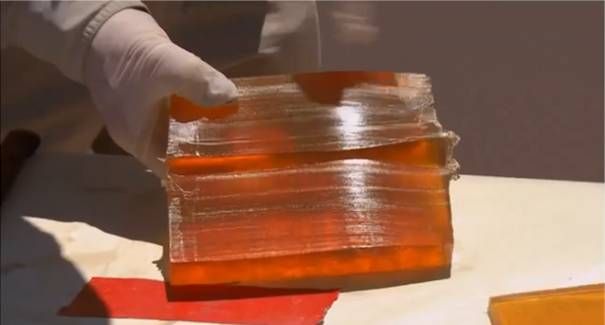
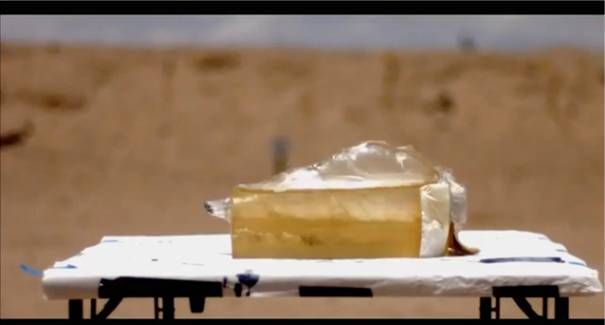
To demonstrate their point, the Haag team fired Carcano rounds through blocks of ballistic soap and gelatin, presumably meant to simulate JFK's neck. Leaving a gap of three feet—which they claim is the distance from JFK's throat to Connally's back—they placed a "witness panel" made of sheet rock at the exit end of each block. According to the show's narrator, "The witness panel records the bullet's orientation after exiting Kennedy's neck." A close-up of the mark left on the panel by one of the test bullets shows a complete profile, demonstrating that the bullet was flying sideways when it struck.
 

Haag then informed viewers that "Connally's coat has this kind of a hole in it". "And", the narrator added, "so does Connally's back, according to his surgeon." This is pretty much what I expected they would say and yet somehow I was still disappointed by the dishonesty. The average viewer would take it for granted that what NOVA was telling them was accurate. But it wasn't. It was a blatant misrepresentation.
 
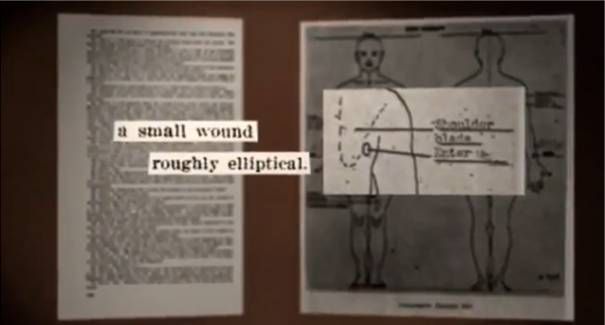
Let's take a look at the image that accompanied that claim:
 

The reader will notice the words "small" and "roughly elliptical" which were lifted from the testimony of Connally's thoracic surgeon, Dr. Robert Shaw. Just how small is small? Let's check Dr. Shaw's testimony and find out:
 
SPECTER: Will you describe Governor Connally's condition, Dr. Shaw, directing your attention first to the wound on his back?
SHAW: When Governor Connally was examined, it was found that there was a small wound of entrance, roughly elliptical in shape, and approximately a cm. and a half in its longest diameter, in the right posterior shoulder, which is medial to the fold of the axilla. (6H85)

So, according to Dr. Shaw, the entrance wound was only 1.5 cm long, which is half the length of the bullet and half the length of the mark left on the witness panel. The holes in the Governor's coat and shirt were approximately the same length, measuring 1.7 and 1.3 cm respectively. (7HSCA138-41) Clearly, then, the bullet was not flying sideways when it struck Governor Connally. I'm sure that the Haag team would still argue that the roughly elliptical nature of the wound was still evidence of a tumbling bullet. But then they're going to have to explain why the entrance wound in the back of President Kennedy's head also measured 1.5 cm (ARRB MD3). Was that also tumbling? If so, why? Their own tests demonstrated how stable Carcano rounds were before striking a surface. So what had that bullet struck before it reached JFK 's head that caused it to yaw? In truth, we don't need the Haag's to answer these questions. Because, as Dr. Shaw explained in his testimony, an entrance wound is often elliptical when it "enters at a right angle or at a tangent. If it enters at a tangent there will be some length to the wound of entrance." (6H95) So, whatever the Haag team or any other Warren Commission apologist wants you to believe, there is no good reason to conclude that the bullet was tumbling when it hit Connally.
 
But NOVA dropped in another fact that they wanted viewers to believe supports their contention that the Connally bullet had already struck Kennedy: the lack of "bullet wipe" around the entrance hole in Connally's jacket. As Haag described it, "bullet wipe" is the "smudgy material on the surface of a bullet that literally wipes off as it pushes through the first surface it encounters." By bringing up the lack of bullet wipe on Connally's jacket, Nova makes the implication that it couldn't have been the first surface the bullet touched. Honestly, even after they moved the back wound up into the neck, I still couldn't believe that NOVA tried to get away with this one. The truth is that whether JFK and Connally were struck by the same bullet or not, no bullet wipe would have been found on the Governor's jacket. Why? Because before it went to the FBI for examination, Connally's wife sent his clothing to the cleaners! In fact, FBI Agent Robert Frazier testified that because of the cleaning, he couldn't even state for certain that the hole was made by a bullet. (5H63) It is my belief that if NOVA knew enough to know that there was no bullet wipe on the jacket, then they had to know that it had been cleaned before examination took place. So once again they deliberately tried to hoodwink their viewers.
 
And it wasn't just the already established facts that NOVA and the Haag's misrepresented to make their case, but also the results of their own experiments. "In test after test", the narrator opined, the Carcano bullet moves straight through tissue simulant, but tumbles when it re-enters the air." Luke Haag added, "That was a real surprise. I can't explain it..." The impression they tried to create was that the bullets stayed straight and true until, in Haag's words, they were "back out into the atmosphere". The reason he can't explain it, is because it's not true. Just a few minutes before making those claims, NOVA showed the path a bullet took through a block of soap.
 

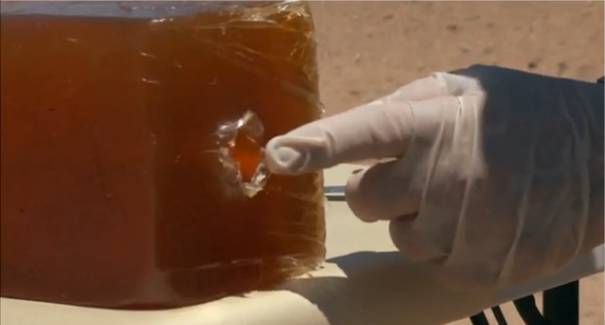
As is obvious, the bullet moves straight for the first few inches, creating a straight and even channel through the block. But as it gets near the exit, "the wound path gets wider". This, Haag explains, is because it is "just starting to yaw". That's right, it starts to yaw before it gets "back out into the atmosphere". And, in fact, one of their tests through gelatin shows this just as clearly because the bullet is flying almost vertically as it exits:
 
 
 So why the lie?
 
The answer is JFK's throat wound. Parkland Hospital's Dr. Malcolm Perry described this wound as being approximately 3-5 mm in diameter (17H29) and having all the appearances of an entrance wound. As he explained in his Warren Commission testimony, "It's edges were neither ragged nor were they punched out, but rather clean cut." (3H372) Dr. Charles Carrico concurred describing the wound as "4 -7 mm...It was, as I recall, rather round and there were no jagged edges or stellate lacerations." (6H3) Dr. Ronald Jones summed it up as a "very small, smooth wound." (Ibid, 54) It is perfectly clear that if indeed a bullet did exit JFK's throat, it was not tumbling. Just compare the above descriptions to this picture of the exit hole created by a bullet "starting to yaw" its way out of the block of soap:
 

Obviously this looks nothing like the wound described by the Dallas doctors so NOVA knew they couldn't get away with saying that the bullet was tumbling as it left JFK's throat. Instead they pretended that the bullets in their tests didn't start tumbling until they re-entered the air even though they had already demonstrated otherwise!
 
Amazing the lengths these people will go to defend the indefensible, isn't it?
 
Head Games
Having demonstrated to Luke Haag's satisfaction that "the Single Bullet Theory as proposed by Arlen Specter is the correct one" (yawn, what a surprise), NOVA turned its attention to President Kennedy's head wound. Everybody knows that the Zapruder film shows JFK being slammed backwards and leftwards by the shot that exploded his skull. And most people agree that this is consistent with a shot fired from the right front, i.e. the area of the Grassy Knoll. This is, of course, supported by the fact that dozens of Dealey Plaza witnesses believed a shot or shots were coming from that very area. But NOVA cannot allow this to stand because it doesn't fit their lone gunman scenario. So they presented Professor Michael Hargather to propound on the difficulty of locating the source of gunshot sounds in urban environments. "Multiples buildings, multiple locations that the shockwaves reverberate off of", he said, "Can give us multiple sound signatures." NOVA claimed that with each gunshot, "an observer can hear two sounds; the crack of the bullet passing, followed by the blast of the gun that fired it." So, as Hargather summed it up, "In a complicated geometry like Dealey Plaza in Dallas, you could get multiple shock reflections in that geometry. And so someone could hear multiple sounds from a single shot." Intriguing stuff. But how does that explain why so many witnesses pointed to two fairly specific locations, the book depository and the knoll, as the source of shots? And if what they were hearing was multiple sounds from each shot reflecting off of buildings, shouldn't the witnesses have reported hearing many more shots than they did?

Regardless, NOVA had once again fooled its viewers. This time into believing that all there was to it was some confusion among witnesses about what they heard. Not once did NOVA mention that a good number of witnesses—including S.M. Holland, Austin Miller, and Thomas Murphy—actually reported seeing puffs of smoke coming from behind the picket fence atop the knoll during the shooting. It has been claimed by Warren Commission apologists that modern ammunition is "smokeless" and therefore, whatever these witnesses saw, it couldn't have been gunsmoke from a Grassy Knoll assassin. But this is not true according to the firearms experts for the HSCA who said that "it would be possible for witnesses to have seen smoke if a gun had been fired from that area" because "both 'smokeless' and smoke producing ammunition may leave a trace of smoke that would be visible to the eye in sunlight. That is because even with smokeless ammunition, when the weapon is fired, nitrocellulose bases in the powder which are impregnated with nitroglycerin may give off smoke, albeit less smoke than black or smoke-producing ammunition. In addition, residue remaining in the weapon from previous firings, as well as cleaning solution which might have been used on the weapon, could cause even more smoke to be discharged in subsequent firings of the weapon."(12HSCA24-5) But you don't need to take these experts at their word, you can watch for yourself videos like this one on youtube showing considerable amounts of smoke from a single rifle shot.


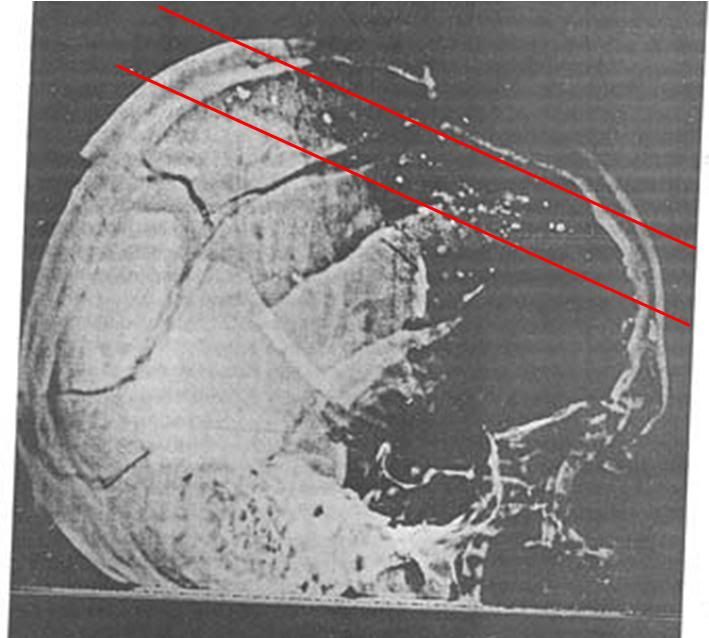
Ignoring all this and making a pretence of objectivity, NOVA used some fancy computer graphics to show that "a trajectory from the Grassy Knoll to Kennedy is possible" (as if we needed a 3D animation to understand that). Then they went out of their way to convince viewers that the medical evidence doesn't support a frontal shot. NOVA made much of the opinions of its pathology expert, Peter Cummings, that fracture patterns on the President's post-mortem X-rays indicate a bullet had entered the back of the skull. But there is very little dispute about this anyway. The rear entrance wound was observed and recorded at autopsy and is easily visible in the right lateral skull X-ray:

 
Equally observable on this X-ray is a track of "missile dust" through the skull that Cummings and NOVA made only passing reference to. We shall return to this point shortly.
 
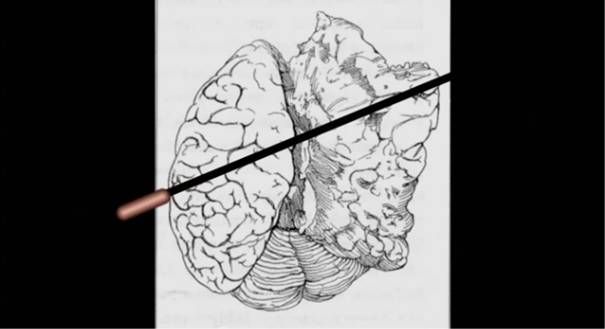
It was pointed out by author Josiah Thompson decades ago that that the rear entrance wound is much lower on the skull than the proposed exit site on the right side. This, of course, makes a straight-line trajectory through the skull impossible. The Warren Commission got around this by utilising another one of its deceptive diagrams, this time showing JFK's head leaning markedly forward as the bullet passed through:
 

But as Thompson demonstrated in his book, Six Seconds in Dallas, the Zapruder film shows the position of Kennedy's head at frame 312, only 1/18th of a second before the bullet struck, was nothing like the above. And that placing the head in the correct position created a severe upward trajectory, close to this:
 

NOVA dealt with this seeming discrepancy by asserting simply that the bullet did not follow a straight-line trajectory. The show featured wounds ballistics expert, Larry Sturdivan, who explained to viewers that the skull bone "is hard enough and strong enough and dense enough to deform the bullet. When it destabilises it begins to yaw. As soon as it begins to yaw it develops a lift force, like an aeroplane wing, and it will inevitably take a curved path."  In simpler terms, the bullet was deflected. In support of this contention, NOVA claimed that when Carcano rounds were fired through skulls at the "Bio-physics laboratory" they "did not follow a straight path inside the skull". They offered no proof of this claim but I am willing to give them the benefit of the doubt since bullet deflection is hardly their invention. In any case, this brings us onto an important point about how NOVA used data selectively to support one scenario whilst ignoring that same data to discount another. Because, having admitted that bullets are easily deflected upon striking the skull, NOVA dismisses the possibility of a shot from the right front by stating that "a shot from the Grassy Knoll would have exited through the left side of Kennedy's brain, but that is largely undamaged."
 
 
Of course, based on the information NOVA itself supplied, there is no reason to believe this conclusion.
 
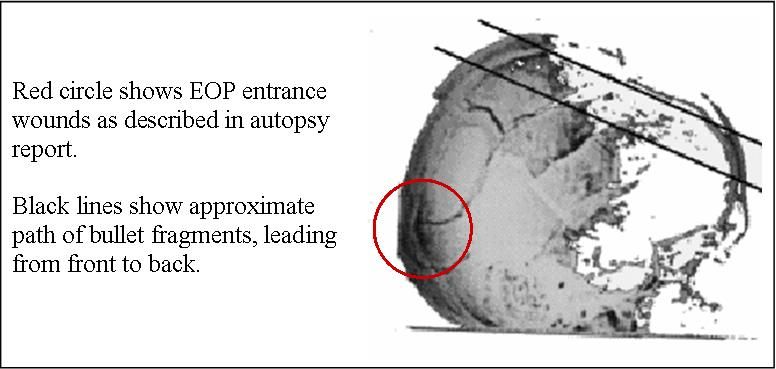
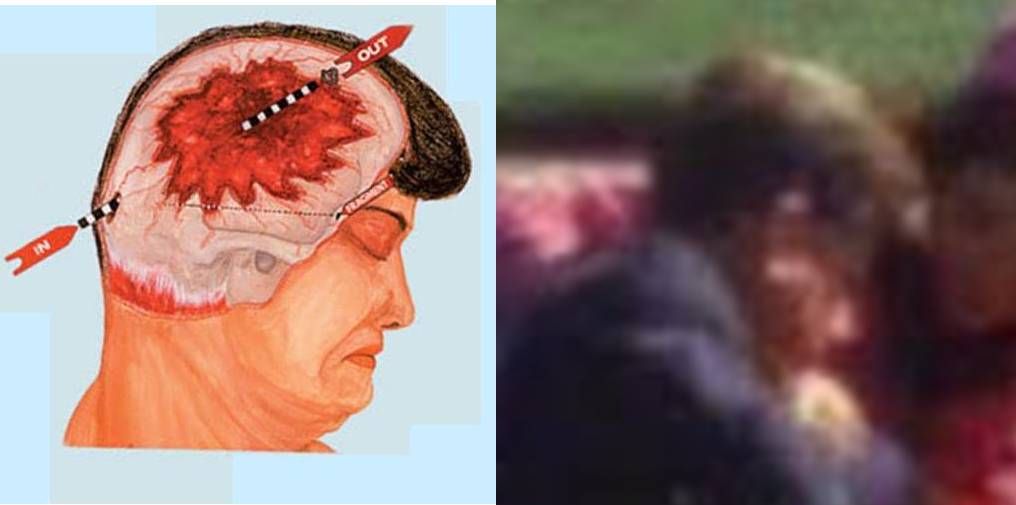
Now let's go back to the evidence that NOVA glossed over; the bullet fragments seen on the skull X-rays. NOVA reported that "The bullet that hit Kennedy's head fragmented, leaving pieces in the brain and in the car." This was their one and only comment on this crucial forensic evidence. They did not expand on it nor did they take a few seconds to show viewers where and how these fragments were distributed through the head. There's a good reason for this. And that is that the path of metallic debris is wholly inconsistent with the a Carcano round entering the back of the skull and is strong evidence of a second shot to the head, fired from the right front. The dozens of tiny particles in JFK's brain, known to experts as a "lead snowstorm", are evidence that the bullet essentially disintegrated after it struck the skull. This is itself evidence of the use of a different type of ammunition to the full metal jacket (FMJ) Carcano rounds Oswald is alleged to have used. The forensic literature is clear that the presence of a lead snowstorm is indicative of a soft-lead, hunting or "frangible" type of bullet since FMJ rounds are designed to stay largely in one piece without leaving a trail of lead fragments in their wake. In fact, the aforementioned Edgewood Arsenal tests showed that, even when they deform and break up, Carcano bullets do not disintegrate in this manner. At most, they leave a few larger fragments near the exit. (see Howard Roffman, Presumed Guilty, photo section) 
 
But more important than any of this is the location of the fragments on JFK's X-rays.
 

The red lines added to the above X-ray show the approximate axis of metallic debris. What should be immediately obvious to those paying attention is that the path laid out by these fragments is in no way related to the entrance wound in the back of the skull. As Dr. Joseph N. Riley has pointed out, the fragments in the brain and the damage to the cerebral cortex cannot be due to the shot described by the autopsy surgeons because the wounds are discontinuous. Dr. Riley, who has a Ph.D in neuroscience and specializes in neuroanatomy and experimental neuropathology, says that the damage to the brain could only be the result of two separate bullet strikes. (see here) That this second shot to the head (more likely the first to actually strike) was travelling from front to back is indicated by the distribution of the fragments. When a bullet disintergrates on striking a skull, the smaller, dust-like fragments are found closer to the entry point and the larger particles are found closer to the exit. This is because the larger fragments, having greater mass, have greater momentum and are carried further away from the point of entry. This is precisely what is seen in the X-ray above, with the smaller particles located at the right temple and the larger ones towards the top back part of the skull.
 
Little wonder, then, that NOVA chose not to go into detail about these bullet "pieces in the brain".
 
Finally we come to NOVA's attempt at explaining away President Kennedy's dramatic backward motion. For this they relied again on Larry Sturdivan who offered viewers the same theory he gave to the HSCA in 1979: The neuromuscular reaction. According to Sturdivan:
 
"The tissue inside the skull was being moved around. It caused a massive amount of nerve stimulation to go down his spine. Every nerve in his body was stimulated. Now, since the back muscles are stronger than the abdominal muscles, that meant that Kennedy arched dramatically backwards."
 
Sound plausible? It shouldn't. As Dr. Donald Thomas explains:
 
"Sturdivan's postulate suffers from a patently anomalous notion of the anatomy. In any normal person the antagonistic muscles of the limbs are balanced, and regardless of the relative size of the muscles, the musculature is arranged to move the limbs upward, outward, and forward. Backward extension of the limbs is unnatural and awkward; certainly not reflexive. Likewise, the largest muscle in the back, the 'erector spinae', functions exactly as its name implies, keeping the spinal column straight and upright. Neither the erector spinae, or any other muscles in the back are capable of causing a backward lunge of the body by their contraction." (Thomas, Hear No Evil, p. 341)
 
And with that, the last of NOVA's bold claims is revealed for the sophistry it is.
 
Thank God It's Over
This wasn't a fun piece to write. It was relatively easy, because there was really nothing new in the show, but it wasn't fun. Having to wade through this type of crap, all these half-truths and misrepresentations, as well as the god-awful pseudoscience, is more than a little tiring. Frankly, it's depressing. Over the last five decades, we have learned a lot about the assassination of JFK. Concerned citizens have dedicated good portions of their lives to studying the evidence provided by the Warren Commission and ultimately found themselves disproving the Commission's conclusions. To find NOVA trying to undo all of that in an hour-long TV special is somewhat exasperating. Especially when one considers the fact that, with the money and resources at their disposal, NOVA could have easily contributed something meaningful to our understanding of the case. That they chose instead to perpetuate the cover-up is shameful.
 
We are all judged by our deeds, and when the truth about the assassination is finally accepted, history will judge NOVA, the Haag's and Sturdivan accordingly.
 
Addendum: More NOVA Nonsense
One point I neglected to address before was NOVA's claim that "Kennedy's shirt collar and tie show a bullet exited his throat". Hmmm. Do they really? Is the evidence as clear-cut here as NOVA makes it out to be? Let's see what FBI agent Robert Frazier had to say when he testified to the Warren Commission: "The hole in the front of the shirt does not have the round characteristic shape caused by a round bullet entering cloth. It is an irregular slit. It could have been caused by a round bullet, however, since the cloth could have torn in a long slitlike way as the bullet passed through it. But that is not specifically characteristic of a bullethole to the extent that you could say it was to the exclusion of being a piece of bone or some other type of projectile." (5H61) [my emphasis] And what about the tie? According to Frazier, the damage to the tie consists of a "nick on the left side...elongated horizontally, indicating a possible horizontal direction but it does not indicate that the projectile which caused it was exiting or entering at that point." (Ibid 62) Seems the evidence is a little more ambiguous than NOVA let on.

So did a bullet exit through the shirt and tie? Well, in his Commission testimony, Dr. Charles Carrico appeared to indicate that the actual wound was above the level of the collar and tie:

DULLES: Where did it enter?
CARRICO: It entered?
DULLES: Yes.
CARRICO: At the time we did not know.
DULLES: I see.
CARRICO: The entrance. All we knew this was a small wound here.
DULLES: I see. And you put your hand right above where your tie is?
CARRICO: Yes, sir; just where the tie--
DULLES: A little bit to the left.
CARRICO: To the right. (3H361-362) [my emphasis]

 Now Dulles's remark, "right above where your tie is", is somewhat ambiguous. So when Harold Weisberg interviewed Dr. Carrico a few years later, he asked him to clarify for the record where the wound was located. As Weisberg reported, Carrico told him it was "above the shirt collar. Carrico was definite on this...when I asked if he saw any bullet holes in the shirt or tie, he was definite in saying 'No'." (Post Mortem, p. 375-376) So, if not an exiting bullet, what else could have caused the slits? Weisberg postulated that they were made by the nurses who cut off the clothing with scalpels. Dr. David Mantik, who has been to the National Archives and inspected the autopsy materials himself several times, confirms this possibility: "The shirt does not exhibit any missing material, but such missing material would be expected for a real bullet. And the lacerations in the shirt do look like the work of a scalpel." (see here)